Ownership of creative work has always been lucrative, and always contested. Usually the person who benefits most from a piece of art is not the person who made it. Sometimes it is. But only when the artist treats the work as an asset, and the management of that asset as a business.
I've worked in and around music for close to 25 years and I've seen a contract or two. Twelve years ago I wrote a longform post about the broken machinery of music licensing. It's an enormous topic, so I kept it to one corner. The right of a venue to play music and build its own atmosphere. Background music for hospitality. Simple.
The piece was well researched, and I parked it. It sat too close to the work I was doing at the time. Freed of those restrictions, I think it's time to share some of it. Not to blame anyone, but to look hard at a business model.
Because here's the question that has followed me for a decade. When a business model is this difficult to understand, is it because the thing being sold is genuinely complex, or because complexity is doing a job?
You be the judge.
I. The tag
In the mixtape era, a producer worked out that the safest place to put your name was inside the record.
Not on the sleeve. In the music. Three seconds of your own voice dropped over the intro, impossible to strip out without wrecking the track. DJ Clue shouting across his own beat. Funkmaster Flex bombing his name over a mix. If those names mean nothing to you, you've definitely heard "DJ KHALED!" bellowed over a song on the radio. Same tradition.
These days it's mostly ego. Originally, it was infrastructure.
The tag did three jobs at once. It advertised you to everyone listening. It proved you were in the room when the record was made. And it made the work hard to steal, because your name was baked into the song itself.
Electronic music had its own versions. When someone made a bootleg house remix everybody wanted, they'd release a shortened edit so no other DJ could play the full version. It was their thing. Or they'd drop a tag over it. In my radio days I did the same. I had a sample that came in just before or after the blend of two tracks. "Nicc Johnson, Session Extraordinaire, Live from Ibiza." Yes, yes. Cheesy. But it worked, because it was entirely normal for other DJs to download your mix, upload it to their own SoundCloud, and claim it as theirs.
En fin. The hip hop producers and DJs figured out the simplest possible way to protect their work. It's why you hear "Missy," "Timbaland," "Darkchild" stamped across most late-90s and early-2000s hip hop and R&B.
No lawyers. No registration. No forms. A signature that travelled with the song wherever the song went.
An entire genre built its own copyright system out of a voice and a microphone.
This came to mind again this month, because I was reading about four seemingly unrelated things, and a pattern kept surfacing through the noise.
The big AI labs have started embedding watermarks in their generated text, so it can always be traced back to their model. Artists are publicly fighting their own rights societies for basic transparency on what their music earned. Businesses have started choosing AI-generated music for their background playlists, because the middlemen have made real music so complicated and expensive that one New Zealand café owner priced his licence at 2,000 cups of coffee a year. And my own royalty statement arrived, alongside an update from my Spotify for Artists account.
Take the watermark first. It's the same instinct as the tag, exactly. Protect the output at the level of the artefact, so nobody can pass it off as their own.
One big difference, though. And it's the whole point.
The producer tagged a beat he made. And when he flipped somebody else's record without clearing it, he got sued, and he knew he would. That was the deal. It meant he was no longer going to make money on the track itself. That is famously the case with Puff Daddy's "I'll Be Missing You," built on a sample of The Police. He made the biggest record of 1997, and Sting, who wrote "Every Breath You Take," reportedly takes the overwhelming majority of the royalties to this day.
Now the AI watermark sits on top of a model assembled from everybody else's work at once, and the argument for taking all of it was that taking it was fine.
Feels wrong, right?
Funnily enough, it's a playbook borrowed from the music industry.
Which brings me to my royalty statement. £106.11. The problem isn't the number. The problem is that it covers maybe 10% of my actual catalogue. Bad metadata has assigned my music to other artists. Payments have been routed to labels and societies and never to me. I've raised it, on and off, for ten years, and it has landed on deaf ears every time. The money itself is modest, perhaps a thousand euros outstanding, but the hoops you're asked to jump through are so absurd that for most artists the process is, frankly, impossible to navigate.
And here's what actually frustrates me, because this is the part I know intimately from the inside. I know exactly what kind of reporting labels and rights societies handle, especially over the last five years.
They have the data. They can see who played what, where, and when. When it's time to collect, they are astonishingly specific. When it's time to pay the artist, the same data becomes opaque, unreliable, and mysteriously missing.
Let me break this down another way.
II. Now imagine the tip
Imagine tipping wasn't optional. Imagine it was law.
Doesn't matter what you came in for. An ice cream, a coffee, dinner, one drink at a bar. You tip. Everywhere. Every time.
Now imagine the amount isn't based on the service provided.
It's based on the size of the bill. Fine, I'm with you so far. But also on how many staff were working the floor that day. How many other people were in the room. How heavy the cutlery is. Whether there's a sommelier. Whether you sat inside or out. How many hours the place was open. The number of tables in the venue. And so on.
Then you're placed in a tipping tier based on how much you earn. So you'll need to show the venue your income, please, so the tip can be adjusted to your tier. What?
And one more. If you choose this restaurant deliberately, you pay a higher rate than someone who wandered into it as a spur of the moment thing, because choosing proves you care about your choice.
You pay. But the money doesn't go to the restaurant. Don't be silly.
It goes to a union, which distributes it fairly, according to its own rules. At the end of the month the restaurant receives an amount from the union. It is not told how the union arrived at that number.
Most of the pool goes to the big chains. Not because their service was better, or because their customers tipped more, but because they're large enough that the union assumes they must account for most of the service happening in the country. So it pays them a percentage and moves on. The chains never complain. The self-owned venue sits on hold, waiting for customer support.
The union pays out the shares as it has calculated them. A slice directly to the staff, the rest to the restaurant, which passes it on, or doesn't, under whatever deal each staff member signed. Nobody on the receiving end is shown the inner workings.
The person who served you never sees what you left. They can't find out what their own service earned. There's no line item, no record, no number they're allowed to look at.
And when they ask how any of it was worked out, they're told the data doesn't exist.
So they're left wondering why Wanda, who only works Sundays, took home more tip money than they did after twenty-three days straight.
Here's the scenario decoded. The customer is the venue. The restaurant is the rights owner, the label or the publisher. The server is the artist. The union is the rights society.
Welcome to the world of public performance licences.
Tell me how this system serves the artists, who want their music played, or the venues, who want nothing more than to build an atmosphere for their patrons.
This one is personal, because it's the thing I tried to fix.
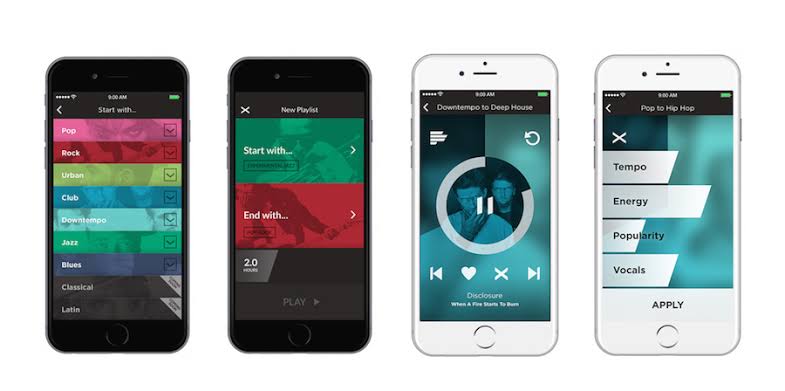
In 2014, in Australia, I sat down with the rights societies, the labels, artists, and venue representatives. We had built an app. You picked the start and end point of a musical journey and how long you wanted it to run. You could steer it in real time, nudge the popularity up, bring the energy down. For venues, we adapted it into vibe templates by time of day. The 8am room is not the 8pm room.
And because every play went through the system, reporting wasn't a burden. It was a by-product. Every track, logged, attributable, ready to pay the person who made it.
We were shut down before we could even get started.
It worked beautifully. That was the problem. It made the value chain too obvious.

III. Two thousand cups of coffee
Earlier this month, a New Zealand café owner did the math.
A year of licensed music, the licence plus the streaming subscription, came to roughly the profit on two thousand cups of coffee. In a year when hospitality liquidations across the country had jumped by nearly half.
So he turned it off and put on AI-generated playlists instead. No licence required. Nothing in the repertoire, nothing to pay.
He said the economy is bad, cafés are closing, and he has to survive first.
Two thousand coffees sounds like rhetoric until you check the rate card. It isn't. It's about right.
And here's the part that should bother anyone who makes things for a living. The café wasn't paying for music. It was paying for permission. And permission is worth exactly what the person selling it can convince you it's worth.
IV. How the meter actually works
In Australia and New Zealand, one body does the collecting. OneMusic bundles the songwriters' rights with the labels' rights into a single licence, and for most cafés, bars and retailers there is nowhere else to buy. The competition regulator has said as much in plain terms. For most of these businesses, obtaining a licence from APRA is their only option.
What you buy depends on what you declare.
If you run a dining venue, you declare your seating capacity inside and outside, your music source, how many days a year you open, how many phone lines can be put on hold at once, and every single day you have live or featured music. If there's music on your website you declare how many tracks are in rotation, and you're required to keep at least ten to fifteen of them, with no two by the same artist.
If you run a pub or bar, you're sorted into one of six tiers priced on how many televisions and music systems you have. They're named Sapphire, Diamond, Platinum, Gold, Silver and Bronze.
Loyalty-programme tier names. For the right to play a song to someone drinking a coffee.
Rates rise with inflation every September. Licensing applies per location. And if your café becomes a wine bar, you change category.
None of this is hidden. It's all published, in guides written in careful, reasonable language. Which is what makes the next part so strange.
V. Two businesses, one room
OneMusic publishes worked examples. Two of them sit in the same guide.
The first is a fish and chip shop with ten seats and a radio. Its annual licence is $258.67.
The second is a patisserie and café with twelve seats that streams music from a digital service. Its annual licence is $1,000.20, or $1,476.85 once you add telephone-on-hold.
Same seat band. Same speakers. Same catalogue. Both licences cover essentially all commercially released music.
The café that chooses its own music pays nearly four times more than the one that lets a radio programmer choose.
Why? The methodology guide answers it directly. The device you use, it explains, indicates the value the music has to your business. A venue playing radio is assumed to care less. A venue running a curated playlist is assumed to care more, and is charged accordingly.
Sit with that. The price isn't set by what the artist receives. It isn't set by what the music does in the room. It's set by inferring how much the buyer appears to care.
There's a word for that, and it's not "royalty."
And it gets stranger. Even at the top tier, the same guide warns that using a consumer streaming service in a business may breach that service's own terms and conditions. So you pay the premium and you're still not clean.
Meanwhile an entire cottage industry of background-music suppliers markets the arbitrage openly. Switch to us, drop a tier, save four hundred dollars a year. Businesses exist to help venues climb down the ladder.
Now change one thing. Same room, same thirty seats, same speakers, but serve wine instead of flat whites.
You move to a different scheme entirely. Your background music is now priced by tier. Put a DJ in the corner and you're charged per person admitted. Charge at the door, or spend enough on performers, and you need a separate event licence. Add dancing and that's another category again.
Identical song. Identical room. Identical audience. The fee tracks your margin.
The organisation has a name for the principle. It calls it the Music Value Hierarchy, and says a version of it has been used by licensing bodies internationally for years. Music in a retail setting, it explains, isn't like music in a bar, because in retail the music isn't directly driving revenue.
Read plainly, you are charged according to how much money the music helps you make.
In simple business terms, that's pay-as-you-grow SaaS pricing. Stripe does it, the fee scales with the money flowing through. The Apple App Store does it at thirty percent.
And as far as business goes, that seems about right. So what the F am I even saying?
VI. The broken logic
Here's the thing that should be obvious and isn't.
If a venue curates its own playlist, it knows exactly what it played. Not approximately. Exactly. Every track, every timestamp, logged by the service it streamed from.
So the premium ought to buy precision. You pay more, and in exchange your money reaches the artists you actually chose. The fee stays the same, the distribution simply gets easier. That's how it should work.
It isn't how it works.
Where a venue streams, the licence fee is distributed using platform-wide data from Spotify and Apple, and a threshold of a thousand streams is applied to keep the volumes manageable. Elsewhere, fees are distributed by analogy. What gets played on radio and television, on the stated assumption that music in bars, restaurants and shops broadly resembles what's on the radio.
Collecting actual reports from licensees, the distribution guide says, would be inefficient and unfeasible.
So the system charges a premium for curation, then discards curation as information. It prices your choices as a signal of value and ignores them as data.
And the proxy is worse than it sounds. Radio playlists are narrow by design, and narrow for commercial reasons. Proven charting songs minimise programming cost, and experimentation carries risk. Using radio as the yardstick for what a café played means allocating money according to a list that was already filtered by somebody else's budget.
Then the threshold does the rest.
Of the 253 million tracks on streaming services last year, 88% were streamed fewer than a thousand times. Over 120 million got ten plays or fewer. Meanwhile around half a million tracks account for nearly half of all streaming.
Apply a thousand-stream threshold to a background music pool and you have quietly excluded roughly 90% of recordings from ever receiving a cent of café money, no matter what the café actually played.
It's the same threshold that keeps those artists off the streaming payout in the first place.
And the money doesn't wait for them. Unmatched royalties are commonly distributed to publishers by market share. Held for a couple of years, then divided among the writers and publishers who already dominate. The emerging artist doesn't just go unpaid. They fund the incumbents.
Which closes the loop.
The café that plays nothing but new local artists pays the top tier, because caring is expensive. That premium is then routed by analogy to radio and to the streaming charts, and whatever can't be matched flows to the majors by market share.
The system taxes discernment and pays ubiquity. The one number that would break the circle, what this venue actually played, is the one thing everybody in the chain can already measure.
VII. "Far from an exact science"
You could argue all of the above is just the cost of doing something genuinely hard at scale. Collective licensing exists because it would be absurd for every café to negotiate with every songwriter. That's true, and it's the regulator's own reasoning for allowing it.
So let's test the hard-problem defence.
Every streaming service reports usage to rights holders in a standardised format, line by line. The track identifier, the country, the subscriber tier, the number of plays. Monthly. In the United States it's a legal requirement. The receiving parties are publishers, labels and rights societies. The granularity is extraordinary and it has existed for years.
APRA AMCOS's own guidance states that its data collection runs to approximately six billion records a year. Its New Zealand arm advertises that over 330 million lines of music data are analysed every month. Its chief executive has described dealing with billions of lines of data every day.
Six billion records a year is feasible. One café's playlist is not.
And it's not that the mechanism doesn't exist. Direct allocation is used, for the largest supermarket chains, and for venues that use a background music supplier with a reporting arrangement. The precise version is switched on when the counterparty is big enough. For everyone else, analogy.
Then there's the Australian musician who decided to find out for himself.
He spent years unable to reconcile his royalty statements. What eventually got him the data wasn't copyright law or his publishing contract. It was privacy law. Data subject access requests under Article 15 of the GDPR and its equivalents, sent to around ten societies. Compliance came only after he escalated to the privacy regulator in each jurisdiction.
Here's what came back.
His German society's records showed fifty-one television usages of his music. He had known about three or four. He had never consented to them individually, membership of his home society had opted him into a blanket licence he wasn't aware of. His publisher didn't know either. When he asked what each usage was worth, he was told, as he recalls it, that this was a trade secret.
His question is the entire argument in one sentence. If you don't know what each use was worth, or what the rate should have been, how can you ever check whether you were paid?
His home society sent a spreadsheet with a disclaimer that the usages might not match reality. He found a single song showing the identical stream count, in the millions, across three different platforms in the same month. A mathematical impossibility. When challenged, they agreed it didn't match real-world usage.
Then two things were said to him by named officers of that society, and they are the most honest sentences in this entire story.
The Director of Writer Services told him they cannot independently verify, access or control the underlying calculation methods of their overseas affiliates.
The General Counsel told him that identifying and collecting royalties, international royalties in particular, is far from an exact science.
Six billion records a year, and no ability to verify how the money arriving from abroad was calculated.
One more detail, because it settles the question of whether the money is actually there. Searching the US mechanical database, the songwriter found dozens of his own works registered but unclaimed, unlinked to his name. He sent the screenshots to his publisher. After months of pressure they ran a global reach-out to their sub-publishers. His income then rose to roughly ten times what it had been.
Not new earnings. The same earnings, finally routed to the person who wrote them.
For context, my own numbers.
My music has been streamed 162,292 times on Spotify, audited, across every profile my name is scattered over. Run that against Spotify's own Loud & Clear data and it puts me roughly in the top ten percent of the thirteen million artists who have ever uploaded a track. I haven't released anything new in twelve years, and I'm still in the top ten percent.
It gets funnier. Fifty-three percent of my recordings never crossed a thousand lifetime streams, so under today's rules they officially earn nothing. One of them stopped at 996.
Four streams short of existing, for the purposes of revenue distribution.
VIII. Applause
There's a reason this matters beyond the money, and the songwriter puts it better than I could.
An artist needs a feedback loop. Not seeing your usage data, he says, is the equivalent of standing on stage with no applause. A call with no response.
I've spent twenty years in rooms watching this work in real time. You know within eight bars. The floor tells you. That feedback is not a nice-to-have, it's the mechanism by which a musician learns what they're doing.
Now consider a songwriter whose music played fifty-one times on German television, who found out six years later, through a privacy regulator, and still cannot learn what a single one of those plays was worth.
The system didn't just withhold his money. It withheld his audience.
IX. The float
If you think this is one organisation having a bad decade, some history.
Every major rights society I know of has had a distribution scandal. The most spectacular belongs to Spain. SGAE's Madrid headquarters were raided by police twice. Once in 2011, when its long-time president was arrested and charged with misappropriating some €20 million, and he was eventually acquitted, in 2022. And again in 2017, when eighteen people were arrested over a scheme known as la rueda. The wheel.
The wheel worked like this. Music was placed on television in the middle of the night, in slots watched by less than one percent of the average audience, registered to the right names, and the royalties from the distribution pool were split between the participants and the TV executives who scheduled it. Fourteen stations were indicted. Some of the "compositions" were public-domain Mozart and Vivaldi, re-registered as copyrighted arrangements. Spain eventually had to change its intellectual property law to cap how much of an author's earnings could come from hours without a significant audience.
Read that again. The distribution-by-proxy system was so gameable that people farmed it from the inside, and it took criminal raids and an act of parliament to slow them down. The international confederation of societies expelled SGAE in 2019, after a report citing conflicts of interest and a distorted and inequitable distribution of royalties.
Now, Australia. The songwriter flagged the numbers first, I went and read the source myself. APRA's FY2025 annual financial report is signed 23 September 2025, audited by KPMG, lodged with the corporate regulator, and sitting in plain sight on APRA's own website. Everything below is from its pages.
$214.657 million in royalties payable. Money collected for rights holders, not yet distributed, on the books at 30 June 2025.
Current liabilities exceed current assets by $55.341 million. This figure doesn't come from an activist's spreadsheet. It comes from the report's own going concern note, the section where directors explain why the company can keep operating. Their explanation is that royalties are technically payable at call, but in practice a portion of that balance, a portion the directors expect will exceed the deficiency, will not be paid within the next twelve months.
Read that again. The balance sheet balances because the directors expect that a chunk of what's owed to rights holders won't actually leave the building this year. The artists' patience is load-bearing.
Administration, finance and legal costs, up 24.7% in a year, from $14.6 million to $18.2 million. Marketing and communications doubled. And the expense line literally named Distribution, the cost of getting money to the people it belongs to, went down 35%.
All of it paid, as everything is, out of member royalties. Which produces my favourite absurdity in this entire saga. When the society ends up in a dispute with its own members, the members fund the legal fees on both sides.
To be fair, and I want to be, the same report shows royalties payable fell by $21 million this year, and the working-capital gap is structural rather than new. It was $52 million the year before. Their transparency reports are also right that a collecting society will always hold undistributed royalties at year end, because collection and matching take time. Every business runs timing gaps.
But look at what this particular timing gap is. Money comes in on a precise, enforced, invoiced-in-advance schedule. It goes out on a discretionary one, through calculations members cannot verify. In between sits a nine-figure float, including $90 million in cash earning 4.13%, and the interest disappears into the same pot the costs come out of, while the people the money belongs to can't see the ledger.
There's a name for a business that takes compulsory deposits, pays out on its own schedule, and doesn't show you your statement.
It's a bank. With very expensive overheads. And it is currently asking the regulator for five more years.
X. Back to the tag
Which brings us back to where we started.
The AI labs took everything. Text, images, music, code, physics papers, novels. The argument being that training on copyrighted work is transformative, and therefore fair. A German court disagreed this year in a case against an AI music generator, and the response from the Australian rights body's chief executive was blunt. Not innovation, theft. In the same month, one AI music company signed a deal with a major publisher that retroactively settled its prior use of that publisher's catalogue, despite never having been sued for it.
Eat first. Pay later.
And on the way out? The labs are locked tight. Their terms prohibit using outputs to train competing models. They've accused each other of industrial-scale extraction, banned accounts, and briefed governments. One company's policy prohibits using its outputs to train any model without authorisation.
And now the watermark, embedded in the text itself, so the work can be traced back to its maker.
Which is exactly what DJ Clue was doing over an intro.
The difference is that the producer knew he was flipping someone else's record, and knew what it would cost him if he got caught. He took the risk deliberately.
The wager here is different, and it comes with a question nobody has answered convincingly.
If the art was free to copy, why isn't access to the model that copied it?
XI. The tell
A business model that requires a maze is telling you something. Adobe was notorious for it, a subscription labyrinth of buried early-termination fees and cancellation dead-ends that eventually got them sued by the US Federal Trade Commission. They've spent the time since walking it back. Adapt or die.
So here's my two cents.
I understand that every business has to run a model that keeps it alive. No argument there. Charge for value, structure it however the market will bear, that's the game, and I've played it for twenty years.
But this is a different animal. This is a model enforced by regulation, granted a monopoly, run on the premise that it exists for its members, not for profit, while giving those members almost no power, and demonstrably not all of their money. When a member asks to see how their own earnings were calculated, the answer is a shrug. When a venue asks what its fee actually bought, the answer is a tier named after a gemstone.
You want to run a model like that? Run it in a free market. Let capitalism sort it out.
Take away the compulsion and watch what happens. Within months of SGAE's expulsion from the international federation, hundreds of Spanish creators moved to withdraw their rights, and alternatives started appearing. Services already exist that license music directly and pay on actual plays. Venues would flock to a licence they can afford, with pricing they can understand, and reporting that routes money to the artists they actually played. The technology has existed for a decade. I know, because I built a version of it in 2014 and watched what happened to it.
If you can measure the value, you charge for the value.
But a system that can't show its working eventually gets replaced by one that doesn't have to.
Sources: NZ Herald (August 2026); OneMusic Australia licence schedules and fee methodology guides; APRA AMCOS distribution information guides and annual transparency reports; APRA Annual Financial Report FY2025 (audited by KPMG, signed 23 September 2025, lodged with ASIC, publicly available at apraamcos.com.au); ACCC authorisation determinations; Luminate 2025 year-end report; Spotify Loud & Clear (2025/2026); DDEX DSR standard documentation; Billboard and Digital Music News reporting on SGAE and CISAC (2011 to 2022); FTC v. Adobe (2024); public statements by the songwriter and his podcast conversation with an independent record label co-founder.